USE [Auxiliary]
GO
SET ANSI_NULLS ON
GO
SET QUOTED_IDENTIFIER ON
GO
CREATE TABLE [dbo].[Nums]
([n] [int] NOT NULL, PRIMARY KEY CLUSTERED
([n] ASC ))
GO
;WITH x00(n) AS (SELECT 1 UNION ALL SELECT 1),
x02 (n) AS (SELECT 1 FROM x00 a, x00 b),
x04 (n) AS (SELECT 1 FROM x02 a, x02 b),
x08 (n) AS (SELECT 1 FROM x04 a, x04 b),
x16 (n) AS (SELECT 1 FROM x08 a, x08 b),
x32 (n) AS (SELECT 1 FROM x16 a, x16 b),
cTally (n) AS (SELECT ROW_NUMBER() OVER (ORDER BY n) FROM x32)
INSERT INTO Nums(n)
SELECT * from cTally
WHERE n <= 1000000;
GO
Based on the CTE used here:
http://sqlreportingservicescrystalreports.blogspot.co.uk/2009/12/auxilary-cte-of-numbers-sql.html
Monday, 28 October 2013

Monday, 28 January 2013
To obtain SQL Server 2008R2 Product Key
To obtain SQL Server 2008R2 Product Key:
USE MASTER
GO
EXEC XP_REGREAD 'HKEY_LOCAL_MACHINE','SOFTWARE\Microsoft\Microsoft SQL Server\100\BIDS\Setup','ProductCode'
GO
USE MASTER
GO
EXEC XP_REGREAD 'HKEY_LOCAL_MACHINE','SOFTWARE\Microsoft\Microsoft SQL Server\100\BIDS\Setup','ProductCode'
GO
Tuesday, 20 November 2012
Convert time to string - SQL
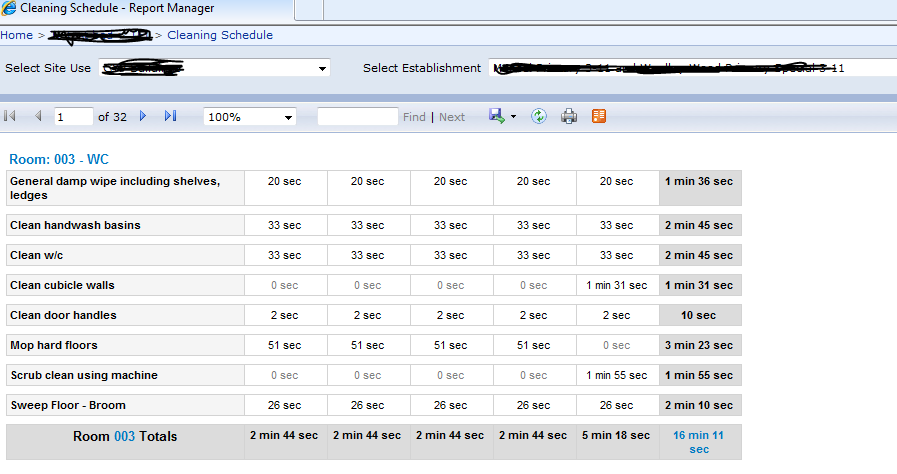
Scenario where a db field contains seconds, the user wanted a SSRS report displaying various aggregates of the seconds field as Hours - Minutes - Seconds.
IFOBJECT_ID('dbo.udf_SCC_TimeToString') IS NOT NULL
DROP FUNCTION dbo.udf_SCC_TimeToString ;
GO
CREATEFUNCTION dbo.udf_SCC_TimeToString
(
@timesec INT) --input in seconds as integer
RETURNSVARCHAR(25)
/*==========================================
Dom Horton
17/10/2012
==========================================*/
AS
BEGIN
DECLARE
@return
AS VARCHAR(25),
@a AS INT,
@b AS INT,
@hours AS INT,
@mins AS INT,
@secs AS INT;
SET@a = @timesec%3600 --get no. of seconds over the hour
SET@hours = (@timesec - @a)/3600 --get no. of seconds of completed hours, divide by hour in seconds to get completed hours
SET@b = @a --hold no. of secs over the hour
SET@a = @b%60--get no. of secs over the min
SET@mins = (@b - @a)/60 --get no. of seconds of completed mins, divide by min in secs to get completed minutes
SET@secs = @a
SET@return =
CASE
WHEN @timesec >=3600
THEN
convert(varchar(10),@hours) + ' hr ' +
convert(varchar(10),@mins) + ' min ' +
convert(varchar(10),@secs) + ' sec '
WHEN @timesec >=60
THEN
convert(varchar(10),@mins) + ' min ' +
convert(varchar(10),@secs) + ' sec '
ELSE
convert(varchar(10),@secs) + ' sec '
END;
RETURN
@return
END
Example below showing the Stored Procedure in use:
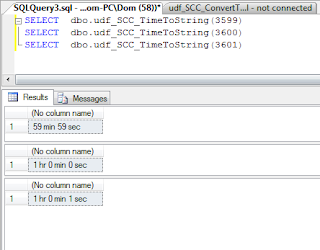
and in use in a SSRS report:

IFOBJECT_ID('dbo.udf_SCC_TimeToString') IS NOT NULL
DROP FUNCTION dbo.udf_SCC_TimeToString ;
GO
CREATEFUNCTION dbo.udf_SCC_TimeToString
(
@timesec INT) --input in seconds as integer
RETURNSVARCHAR(25)
/*==========================================
Dom Horton
17/10/2012
==========================================*/
AS
BEGIN
DECLARE
@return
AS VARCHAR(25),
@a AS INT,
@b AS INT,
@hours AS INT,
@mins AS INT,
@secs AS INT;
SET@a = @timesec%3600 --get no. of seconds over the hour
SET@hours = (@timesec - @a)/3600 --get no. of seconds of completed hours, divide by hour in seconds to get completed hours
SET@b = @a --hold no. of secs over the hour
SET@a = @b%60--get no. of secs over the min
SET@mins = (@b - @a)/60 --get no. of seconds of completed mins, divide by min in secs to get completed minutes
SET@secs = @a
SET@return =
CASE
WHEN @timesec >=3600
THEN
convert(varchar(10),@hours) + ' hr ' +
convert(varchar(10),@mins) + ' min ' +
convert(varchar(10),@secs) + ' sec '
WHEN @timesec >=60
THEN
convert(varchar(10),@mins) + ' min ' +
convert(varchar(10),@secs) + ' sec '
ELSE
convert(varchar(10),@secs) + ' sec '
END;
RETURN
@return
END
Example below showing the Stored Procedure in use:

and in use in a SSRS report:
Thursday, 6 September 2012
Missing indexes - SQL
SELECT index_handle, database_id, object_id, equality_columns, inequality_columns, included_columns, statement
FROM sys.dm_db_missing_index_details
FROM sys.dm_db_missing_index_details
Index usage - SQL
SELECT OBJECT_NAME(I.object_id) AS TableName, I.name, I.index_id, I.type_desc, I.is_unique,
I.fill_factor, I.is_padded, I.is_disabled, I.is_hypothetical,
IUS.index_id , IUS.user_seeks, IUS.user_scans, IUS.user_lookups, IUS.user_updates, IUS.last_user_seek,
IUS.last_user_scan, IUS.last_user_lookup, IUS.last_user_update, IUS.system_seeks, IUS.system_scans, IUS.system_lookups, IUS.system_updates,
IUS.last_system_seek, IUS.last_system_scan, IUS.last_system_lookup, IUS.last_system_update
FROM sys.indexes AS I LEFT OUTER JOIN
sys.dm_db_index_usage_stats AS IUS
ON I.object_id = IUS.object_id AND
I.index_id = IUS.index_id
ORDER BY OBJECT_NAME(I.object_id)
I.fill_factor, I.is_padded, I.is_disabled, I.is_hypothetical,
IUS.index_id , IUS.user_seeks, IUS.user_scans, IUS.user_lookups, IUS.user_updates, IUS.last_user_seek,
IUS.last_user_scan, IUS.last_user_lookup, IUS.last_user_update, IUS.system_seeks, IUS.system_scans, IUS.system_lookups, IUS.system_updates,
IUS.last_system_seek, IUS.last_system_scan, IUS.last_system_lookup, IUS.last_system_update
FROM sys.indexes AS I LEFT OUTER JOIN
sys.dm_db_index_usage_stats AS IUS
ON I.object_id = IUS.object_id AND
I.index_id = IUS.index_id
ORDER BY OBJECT_NAME(I.object_id)
Subscribe to:
Posts (Atom)